
 This Theosophical Encyclopedia contains all the articles of the printed
  Chinese, Simplified
 English
 Français
 Español
 Chinese, Traditional
Edward T. Sturdy - 'Father of Theosophy in New Zealand'
Published in TheoSophia magazine, September 2019, by The Theosophical Society in New Zealand. Article by Richard Sell
In May 1887, H.P. Blavatsky arrived in London and stayed with Mabel Collins (Light on the Path, Idyll of the White Lotus) in a cottage called ‘Maycot’ in Norwood, which was located near the famous Crystal Palace associated with Prince Albert. Their relationship was a somewhat tumultuous one, but during this time ‘Maycot’ was a hive of theosophical activity.
After four months Madame Blavatsky was on the move again, this time to Lansdowne Road, Notting Hill where Bertram Keightley and his nephew Archibald (who was older) looked after her. Later, Mabel was living at Clarendon Road and her garden backed onto that of Lansdowne Road. So although she was not part of HPB’s household, the two women developed the habit of signalling one another across the gardens when they wanted to talk.
In July, 1890, HPB and her staff moved from Lansdowne Road into Annie Besant’s house at 19 Avenue Road, St Johns Wood, which is very close to Regents Park. Within a month she had formed the ‘Inner Group’ of the Esoteric Section, which consisted of twelve members, six men and six women. These personal pupils of HPB’s are very familiar to theosophical history; Countess Constance Wachtmeister, Mrs. Isabelle Cooper-Oakley, Miss Emily Kislingbury, Miss Laura M. Cooper, Mrs. Annie Besant, Mrs. Alice L. Cleather, Dr. Archibald Keightley, Mr. Herbert Coryn, Mr. Claude Falls Wright, Mr. G. R. S. Mead, Mr. E. T. Sturdy, and Mr. Walter Old. There were also two "outsiders" that had been specially invited, namely, Rai B. K. Laheri and Dr. William W. Westcott, who were later joined by W. Q. Judge.
Alice L. Cleather describes in her book, H. P. Blavatsky - As I knew Her …
“The group held its meetings weekly, in a room which had been specially built for it, leading out of HPB’s bedroom. Into it, no one but herself and the members of the group ever entered. Each member had their own place and chair; and during the instructions, HPB sat with her six men pupils on her right and the six women on her left-hand side, in semi-circular formation”.
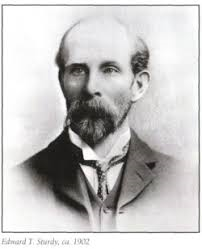
E. T. STURDY
One of these 'Inner Group’ members has quite an association with New Zealand; Edward Toronto Sturdy. Born in 1860 in Canada in Toronto, whence his middle name comes from, he came to NZ when he was 19 years old. He was during his life a Sanskrit scholar, student of Hinduism and Buddhism, and a member of the Theosophical Society. He was, as just mentioned, a part of the Inner Group formed by H. P. Blavatsky and the one who recorded what is today known as HPB's Diagram of Meditation.
In 1884 he was living in Woodville which was part of the Hawkes Bay region at that time. He had heard about the Theosophical Society through a friend and being greatly interested he wrote to Adyar. He joined the Society on the 10th October 1885 as one of the first ten New Zealanders to become a member (he was the 9th). Colonel Olcott referred to Mr Sturdy as the “Father of Theosophy in New Zealand”.
Edward Sturdy was interested in Indian philosophy, and so in the next year he went to Adyar hoping to get in touch with "learned Hindus". In Islands of the Dawn it describes how it was the Bhagavad Gita that piqued Sturdy’s theosophical interest ... “I felt that in the ‘Gita’ there was teaching I had been seeking for long”.
For a short time around March, 1887 he joined H. S. Olcott who was on a tour in Northwest India. Col. Olcott talks about Sturdy and the other Allahabad members once meeting him at the station on his arrival from Benares. Sturdy then left for Ceylon (now Sri Lanka) to attend to some business for the TS. Later still, he travelled to London and met Madame Blavatsky, who had just moved there in May and was settling in at ‘Maycot’.
After a few months in London, Mr. Sturdy returned to New Zealand by way of New York. It is here that he met William Quan Judge. Once back in NZ he says he “lived in a hut on the outskirts of Wellington” where he gathered some keen students around him, which eventually lead to the formation of the first lodge in New Zealand, the Wellington Lodge, chartered in November 1888.
Among its members were Sir Harry Albert Atkinson, Prime Minister of New Zealand; his wife Anne E. Atkinson; their son, E. Tudor Atkinson; M. van Staveren, a Jewish rabbi; H. M. Stowell (Hare Hongi), a Māori tohunga (priest); and Edward Tregear, a poet and Maori scholar who wrote a book about the similarities of the Hindu and Māori languages.
Sturdy did inaugurate a flurry of theosophical activity with a magazine called Hestia, and later The Monthly Review, described on the title page as ‘A Magazine Devoted to the Teachings of the Ancient Sages and the Study of Philosophy and Science’ which Robert Ellwood (Islands of the Dawn) says “was a remarkable effort in that lofty direction for a setting like New Zealand in 1888”. Mr. Sturdy left for England in December 1888, never to return to NZ, to become a student of Madame Blavatsky with her Inner Group. After his departure the Wellington Lodge ceased to exist, although it was rechartered in 1894.
Edward Sturdy was a member of the "E.S.T. Council" appointed by HPB and he was also part of the European Advisory Council formed in July, 1890, which would assist HPB in her new function as the Presidential authority of the Theosophical Society in Europe. The other members of the Council are all well known in theosophical history; Annie Besant, W. Kingsland, Herbert Burrows, A. P. Sinnett, H. A. W. Coryn, and G. R. S. Mead.
In 1895 Swami Vivekananda was in America and he was invited to visit London by Miss Henrietta Müller who had already met Vivekananda in America. Mr. E. T. Sturdy requested the Swami stay at his home in England. Vivekananda gave a lecture October 22, 1895, at Prince’s Hall, with Mr. Sturdy as the Chairman. Eventually, Swami Vivekananda and Mr. Sturdy began to work together on an English translation of the Bhakti aphorisms of Narada. After a two month stay in England, before leaving, he arranged that Mr. Sturdy should conduct classes in London until the arrival of a new Swami from India.
Another testimony of his pursuit of Eastern philosophy comes from the Greek writer Lafcadio Hearn (a.k.a. Koizumi Yakumo, his Japanese name) who wrote to a friend in April, 1898:
I have met a most extraordinary man. . . . His name is E. T. Sturdy. He has lived in India --up in the Himalayas for years-- studying Eastern philosophy; and the hotel delicacies will do him no good, because he is a vegetarian. He is a friend of Professor Rhys-Davids, who gave him a letter of introduction to me; and has paid for the publication of several Eastern texts--Pali, etc. Beyond any question, he is the most remarkable person I have met in Japan. Fancy a man independent, strong, cultivated, with property in New Zealand and elsewhere, voluntarily haunting the Himalayas in the company of Hindoo pilgrims and ascetics,--in search of the Nameless and the Eternal. Yet he is not a Theosophist exactly, nor a Spiritualist. I did not get very near him--he has that extreme English reserve which deludes under the appearance of almost boyish frankness; but I think we might become fast friends did we live in the same city. He told me some things that I shall never forget,--very strange things.
Sturdy married in 1894 and had a son and daughter, but sadly was widowed by 1901. He was a successful property developer and we find him moving from London to Dorest with his small children to a village called Burton Bradstock, where he remodelled the lovely ‘Norburton House’. He lived in this house for 50 years. The Sanskrit inscription over the fire place in the main hall (around 1906) says “SATYAT NASTI PARA DORMA” has been translated by the British Museum to read ‘There is no higher law than truth’.
The original Sanskrit is Satyan nasti paro dharmah. This was the family motto of the Maharaja of Benares and is a somewhat modified passage from the Mahâbhârata. Col. Olcott adopted it for the Parent Society around December 1880. Another fireplace, the dining room, was adorned with serpents. The serpent or ‘Nagas’ in Sanskrit, is a symbol of ‘Wisdom’ and is found in the Theosophical Society’s emblem.
Mr Sturdy wrote a number of articles including Gurus and Chelas to which Annie Besant penned a reply, and a book called Theosophy and Ethics. In 1894 Mr Sturdy resigned from the Society to work independently as he was inspired by not only by H.P. Blavatsky and theosophy but also by Advaita Vedānta and Mahāyāna Buddhism.
In 1947, he wrote: "I think I must have been the most skeptical of all the members of HPB's Inner Group". He then proceeds to say that in time he had come to believe in Mme. Blavatsky and also in the Masters of Wisdom as "concrete individuals" and not only as ideals.
In a letter to Boris de Zirkoff dated 18 April, 1947, he wrote: "I am the last of all her Inner Group. I live almost the life of a hermit, for my contact with the outer world is almost entirely by letters".
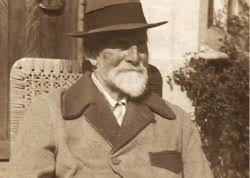
In March 13, 1957, Mr. Sturdy had a slight stroke from which he recovered. However two days later, on March 15th, he passed on suddenly after lunch "without even a sigh", aged 97. It is reported he was reading an article on life after death in Buddhist thought written by his friend Christmas Humphreys.
Reference: https://theosophy.wiki/en/E.T.Sturdy